In this time of great uncertainty in Lebanon, we at TM are trying to continue to be a steady presence in the lives of refugee families living here. There are many practical obstacles facing us at the minute. Frequent roadblocks make transport more difficult. Worries from rumors of intimidation make parents wary to send their kids to school.
However, the work we are involved with is all the more important in a time such as this. Several weeks ago, I had a conversation with a few teachers at the school in the Bekaa, who mentioned that they and another families had been hearing messages of intimidation on social media. The one they pointed me to was seemingly a threat to kill any Syrians who came near the protests. Other families have told me that they are afraid that the anger and frustration might spill over against them and, specifically, that they are worried their tents might be set on fire in the night while they sleep.
It is hard for us to know whether these threats were genuine or not, but the fears they point to are very real. In Syria, the civil war was sparked by anti-government protests, and, due in part to their previous experiences, many refugees fear a repeat of that here. They also recognize that they are in an incredibly vulnerable position here in Lebanon, with limited physical and almost no political protection, should the situation shift. The fear and stress this brings to families and even to the children themselves, who often overhear conversations like those above, is obvious.
As followers of Jesus, we know that we are constantly cared for and protected by Him – looked after and held in God’s hands, no matter our external circumstances. We desperately want to share this peace – this deep assurance of His love and safety – with those around us. We long for this ministry to continue to be a tangible expression of an unseen reality, showing the vulnerable in some small way that God is here, sees each one and is more than able to hold them in His care, His love and His peace. And we dream and pray that those we reach out to in this way would come to know Him for themselves.
Protests are still going on, the government has resigned and we are going into the unknown.
Protests in Lebanon started on the 18th of October against the corruption of the political sectarian system, which has political leaders controlling the whole country without accountability, the judicial system, and the army are also controlled, by the same corrupted politicians.
Lebanese people have raised their voice and the system is shaken and Lebanon is moving towards a radical shift. From all levels of society the Lebanese are heading to the streets. Roads are closed by protesters who are rightfully demanding a change and for a government of technocrats. Some are chanting and others dance and sing for change.
At Triumphant Mercy we have closed our doors for 2 days in Beirut but reopened shyly for half days as many people are reluctant to move around specially from the Syrian community. With the high level of excitement in the streets it is not hard to imagine clashes so people are afraid to move around
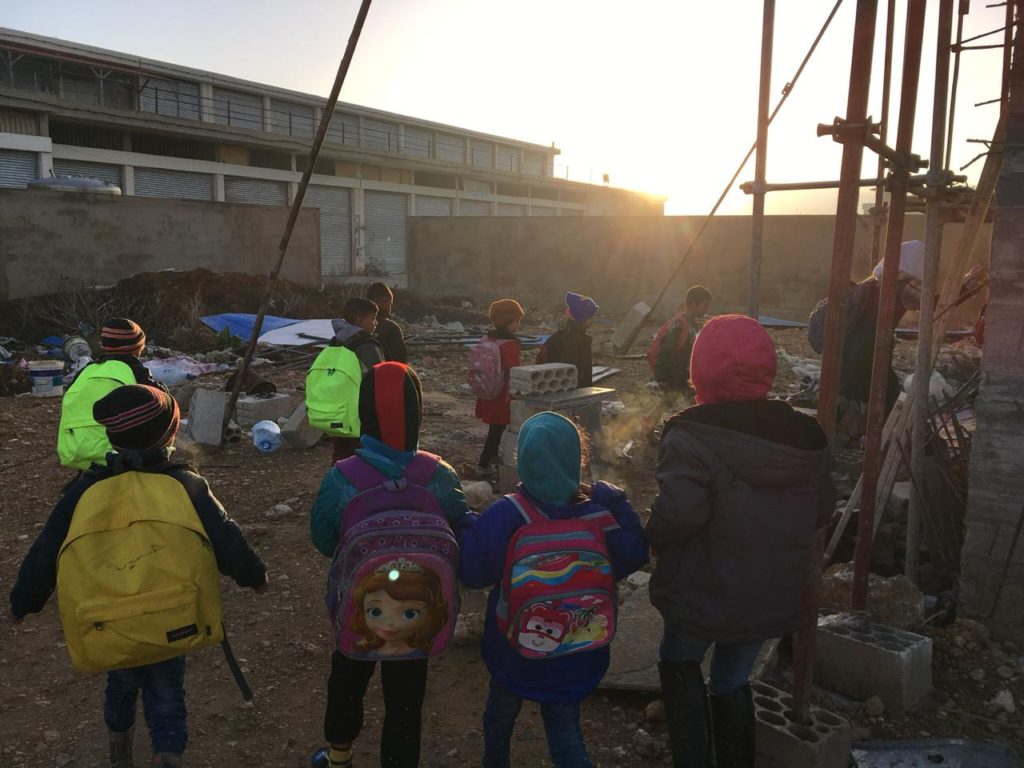
In Zahle, our challenge is to keep our children feeling safe to come to school by taking alternative routes. Many Syrians are concerned having already lived through turmoil that the protests will boil over, and the children are overhearing the conversations of concerned adults. Difficulties with cash and fuel are making this time more difficult specially for the bus drivers who are struggling to fill up their vans to pick up the children each day and return them to their homes.
We don’t know what the future holds and how all these events will develop. What we know is that we will keep serving , keep loving, keep bringing hope in people’s lives and keep fighting to see a transformation around us.
Each child is beautifully crafted in their mother’s womb. They each have a destiny and a future. Each one is born into life with a purpose and they deserve to be able to grow into that purpose and their childhood should not be stolen from them. They deserve the carefree time in their lives that they can run wild, get dirty, play, laugh until their bellies hurt, and most of all to learn. They deserve the foundation of a steadily growing understanding of how the world works and they deserve not to be forced into the adult world.
Though every child who experiences trauma, displacement or hardships can have this time of their life disrupted it’s the girls who feels it most. According to the UNHCR girls are registered to school at half the rate that boys are registered. Many of these girls are not only kept home to work with their mother’s with the claim that “she does not need school” and then they often are married at the young ages of 14, 15, or 16. These girls have no chance to even experience all their childhood without the pressure to become a mother and be a good wife, things that should be reserved for adulthood.
At Triumphant Mercy we fight for childhoods, believing that if a child can grow and learn at their own pace, this will allow them to become healthy flourishing adults. We sit with families and explain the benefits to their family, their daughter and her future family by allowing her to study, by allowing her to be a young woman and girl in her time. We do this knowing that it extends far beyond her and the family but to the communities and the futures of nations.
We cannot allow this generation of girls to continue to have childhood taken. We can stand up and choose to stand with her against those things that would stand in her way. We can help her to push them to the side, and then stand behind her as she walks into her destiny.
We’ve been back at school in Zahle for four weeks now. The atmosphere right now is enthusiasm and relief! The summer holidays feel especially long for these families: our teachers tell me that having their kids at home, unoccupied, all day was tough going. There aren’t many safe spaces for play and trips out are rare.
The kids are visibly excited to be back, and more focused than before the holidays. We asked some of our English classes to tell us about something that happened in their summer. Best bits included football with friends, going swimming and falling in love. One girl’s father returned from working far away from the family – her smile was huge! Most of the time, they say, was boring. Lots of sitting at home, some time playing with friends. They’re glad to be back.
We’re aware as we work with them that these kids are like plants removed from the soil. Their lives lack so many of the conditions that support growth, and they can only survive so long like this. One of my highlights last term was teaching a couple of beginner classes the phrase, ‘My school’. You can say that, you know. This place is yours. There was a lot of pride and ownership in being reminded of that, and it made for some fun classes together. We are only ever a temporary solution. We believe – and see – that being in a place of safety for this time is vital, but we are like a small plant pot for growing trees. We provide some good soil for this time, but, left in a small pot, the tree will never thrive. This is not what we dream for them.
This year, one key focus will be ensuring that the kids who are with us – at every level of ability – are as well prepared as possible to return to school in Syria. We dream of sending back young saplings who have been well served by their time with us. We dream that they would go strengthened, with some resilience and good resources that will help them to grow deep roots and to stretch up high, to repopulate places that have been deserted or destroyed with their beauty, passion, fruit and life. We hope and pray that they can reintegrate, and that their families would be equipped with fresh courage for the journey, and for the hard work of rebuilding that awaits. We pray for a place ready to receive them – for safety from violence and an amnesty from harsh consequences to their absence, especially for those men who have left military service or avoided it altogether. We long, more than ever, for these gospel seeds that have been scattered to take root and bring radical transformation to these places, families, and individual lives. Let’s be clear: These things, if they happen, will be a miracle. But we pray to a God who makes life from dust. We live life by His grace, and we believe that we are led by Him to pray for even more than we could ask or imagine.
This article was originally published on Missions Network News you can go to the original story from here.
Syria (MNN) — Host countries of Syrian refugees are telling them it’s time to go home, but according to Nuna of Triumphant Mercy, home isn’t as safe as some might hope.
As some governments claim, some places in Syria are relatively safe, and some refugees are admittedly reluctant to return not because of safety but because of the economic stability they’ve found in their host countries.
However, “there’s also truth in the pressure and in the difficulties of some families to go backbecause of deserting the Army or because of the alliance against the government,” Nuna says. “If they proclaimed themselves against the government, going back to Syria after this government would be a bit difficult.”
This increased pressure is uprooting families and individuals who are already weary and battered. Nuna says these refugees may no longer live in fear of losing their lives, but they do face “the trauma of being arrested, the trauma of being taken prisoner, of being beaten, and of being forced into signing something or doing something that you don’t want to do.”
Thanks to their work with refugees, Triumphant Mercy sees the frontline of this discussion. They’re working to develop economic stability for refugees, but with official eyes on them, they’re doing their best to show that they care for both Syrians and Lebonese.
As the situation shifts, so too will their mission. “It’s not just me; it’s everybody now,” Nuna says. “Every NGO is doing that. They’re all shifting gears, they’re all going in a different direction. Even though we’ve been focusing on very much like on Syrian refugees who are here, we’re trying to differentiate between the Syrian refugees who are here to receive help, or just because it’s easier on them, or those who are really needing help and needing to be supported in Lebanon.”
For years, they’ve been working to help displaced refugees feel safe. “People started to feel that they can start a life, that they got out of the trauma,” Nuna says. Now, with new pressure from host countries, “the trauma’s back. Now they sleep not knowing if, at four in the morning, the camp will be surrounded by the military just coming to take people to prison.”
That being said, they’re still trying to guide refugees who are interested in returning home, telling them “We can help you even there, we can direct you somewhere, we can just give you some tips and points. But it’s better for you to actually go back home and start to build.”
In short, these are people who are looking for hope. They need something steady to hold on to in times of turmoil and a source of peace as their world shifts once again.
That’s what makes Triumphant Mercy so uniquely equipped to take on this challenge. “We’re a Christian agency before we’re a humanitarian agency, and we have a message and we have a desire to see God’s kingdom expand,” Nuna says.
“We believe that every person we see, we need to encourage, bring hope, show them a different view, and let them see that the hope is not gone, and everything is not black.”
This new pressure is proof that any sense of stability based on politics or the material world is can be taken away. That’s why Triumphant Mercy focuses “on the real issue, and the real issue is what do you have inside you and the real peace that they can have when they just give everything to Christ and you let him direct your life.”
Pray for Syrian refugees wrestling with the choice of whether or not to return home, and ask God to give Triumphant Mercy wisdom as they come alongside Lebanese and Syrians. You can learn more about Triumphant Mercy right here.
“People are suffering. People are traumatized. People don’t have a future. People don’t see a future, they can’t imagine a future,” Nuna says.
“If we join together, if we all have a goal in mind, we can actually do something, and I really want to encourage people to take a stand to just say ‘It’s not acceptable. We got used to it, but it’s unacceptable.’”
One hundred and thirty kids were registered to come for camp. Everything was prepared, a team from Egypt was there to help us and the buses were bringing the kids from the refugee camps to the front gates of our center in Zahle. Two Egyptians for each group were checking kids in and giving them their group color. It was noisy, and most kids could not stand still from anticipation. Some kids we knew from the school and some were brand new to the center. Though a bit chaotic, it was an organized excited chaos. As the kids were lining up I noticed one girl who had been in my group therapy classes at the school, her name is Nawrieh. Now my heart has always gone out to her because her mother is very harsh with her and speaks very poorly of her in front of the other children, guests and Nawrieh herself. Each time her mom says something about her you can see Nawrieh, a normally funny, outgoing girl, pull back when she hears her mother’s words. Though completely capable Nawrieh gets nervous when put on the spot and her backup when she feels cornered is aggression. I walked up to her as I saw she was beginning to get a bit combative with another girl and I pulled her aside. Through a translator I reminded her that I needed her help because she goes to the school and I needed her to show the other kids who didn’t how we act in school. Then I made her “pinky promise” me that she would do it. After that each time I needed to remind her to behave better I just had to give her the “pinky promise” and meet her eyes and see the understanding cross her face. Though her behavior was not perfect, she became one of the best behaved students in her group. And on the last day, with one last “pinky promise” and a kiss on the cheek she headed out the door and down to her bus to go home. As the kids all left the team exhaled a deep breath of a crazy but rewarding week creating an atmosphere of love and presence of Christ for all the kids who walked through our gate. Kelsie
A new activity that the new community center is allowing us to experiment is art therapy. The staff member running the group reports:
Seven weeks ago, I started a women’s art trauma therapy program with young Syrian refugee women. I invited young women who are “too old” to attend school and are “too old” to be able to leave their homes unattended. For half the class this is the only time they leave their homes during the week. Other women in the program are young brides and mothers.
We started the program looking at pictures and talking where we saw light and darkness in them. We continued to talk about light and darkness we could recognize in our own lives and the importance of having a source of light. As the weeks continued we have talked about our uniqueness and appreciating our differences in art, but also as human beings and friends.
One woman said the third week she always dreamed of being an artist when she was small, but she had forgotten after she got married at 16 and had two children. Now she feels like her dream is coming true.
Tuesdays are a healing day at the Triumphant Mercy Community Center in Beirut. Kids and moms from the school have therapy classes but at the same time a safe place for the women of the community is created. The women come in to the smell of the fresh za’atar maanaesh and hot tea. They are settling in to speak about their lives. Each week there is a therapeutic theme.
This week they are talking about problems and giftings. Most refugees are used to sharing their problems with NGOs. But this week the class leader will be focusing on how their own God-given giftings can help them solve their own problems. Each woman sits with an empty sheet of paper in front of them. It is folded in half on the first half they are told to write out a problem they have. Then on the other side of the paper, they are instructed to write out gifitings that they have. They are then told to unfold the paper so before them they are looking, not only, at their problems but they are looking at their God given giftings that will enable them to conquer these problems. This sprung conversation and seedlings of hope that they had been given a way to address their problems, instead of feeling helpless and hopeless to overcome them.
During sharing time one woman gave an example of how she used her giftings to continue to bring both money and food for her family by selling things she made to close the gap between what they had and what was needed for her family.
Another week there was an opening up of women to speak about their home lives and generational issues. Women talked about how their mothers were mistreated by their fathers and their mother-in-laws and how the problems continued to them. They mourned what they didn’t see and were able to share candidly, woman to woman how this affected them and what they want for the future and for their daughters. Helping to break the cycle of “this is how it is” and show their children better lives.
Last week as two women left they made a comment to the teacher that this was one of the places and times they could come and speak freely and express themselves openly, The center is to them not only a place to get things and receive help, but a safe place, a place of refuge.
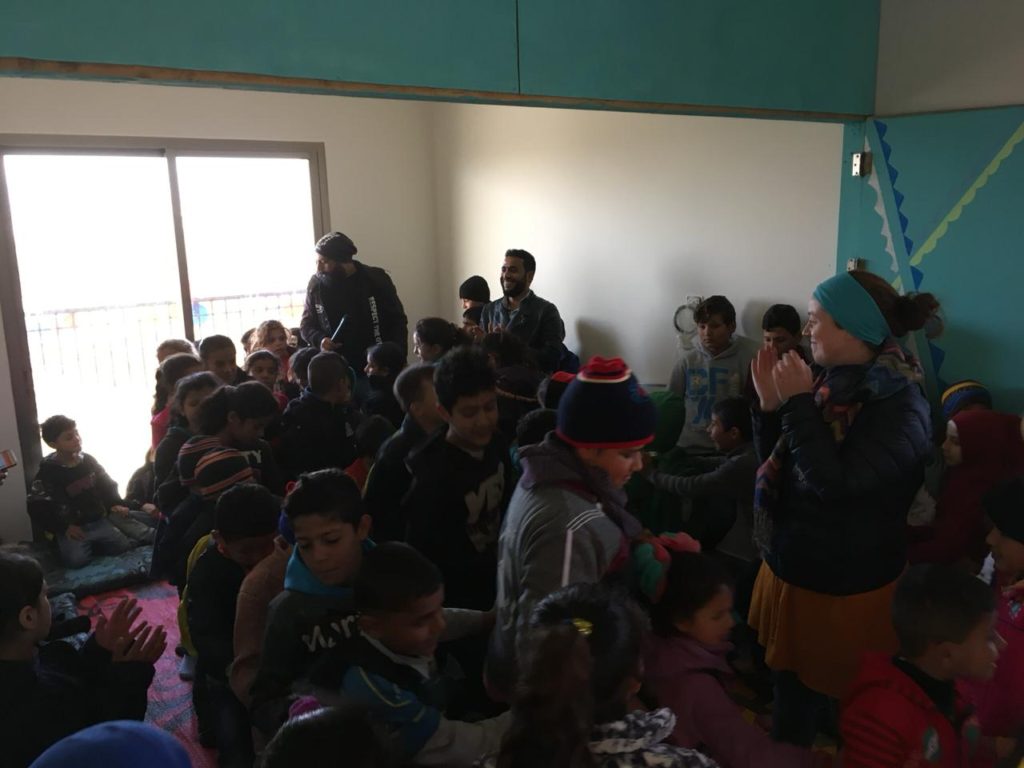
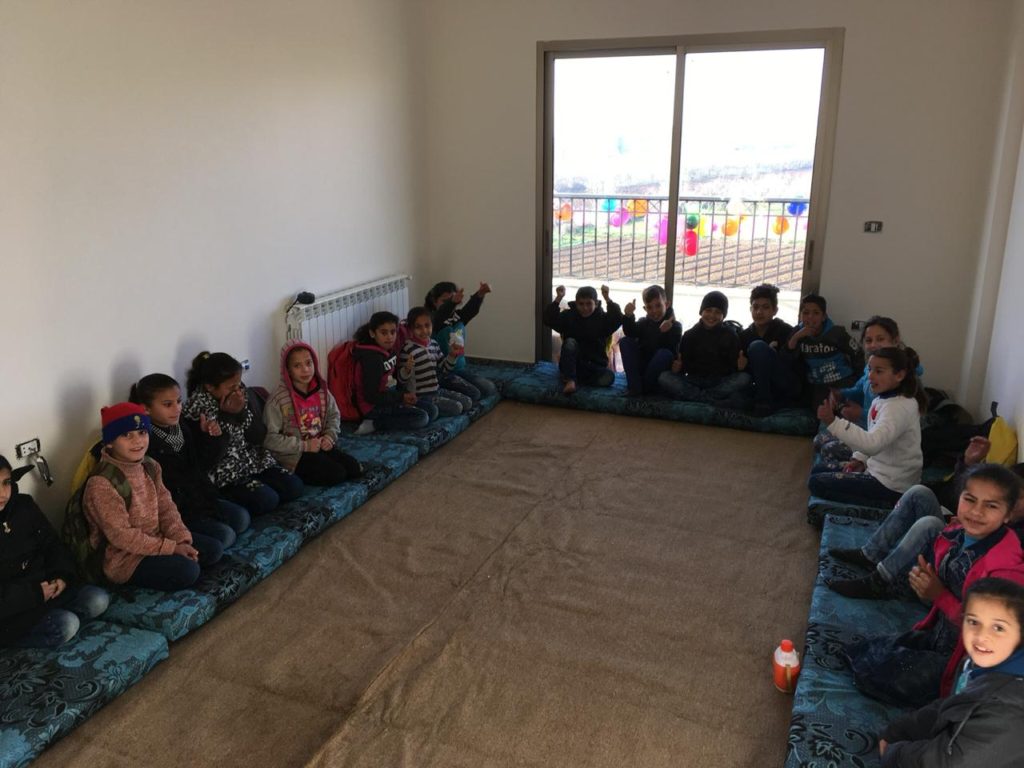
One bright, chilly Monday morning in January I arrive at the new building and see colorful balloons hanging across all the balconies; the teachers hung them there the day before. I start to walk and 2 buses arrive bringing over 300 children. It is the first day of school this year and in our new location. They picked their way over piles of garbage, broken tiles, wires, rebar poking out of the building and made it to the back door; eyes wide and full of anticipation. They begin to push in excitedly and pile their shoes at the base of the stairs. Heart-shaped balloons also line the stair railing, welcoming the little people. Their teachers guide them to the new classrooms and they gasp in delight when they see the brightly painted walls and new room furnishings. I hear hushed tones as they whisper that it is beautiful.
Half an hour later I grab a roll of tape and recruit a teacher to help me cover exposed outlets with wires poking out and take a picture to send and make sure someone comes to put the covers on as soon as possible. As we finish with the outlets an overseer of the workers respectfully interrupts a conversation and asks if some of the male teachers can help them carry the heavy boiler for the radiators to the roof.
I hear a teacher giving an instructional lesson about how to use the new western style toilets. They take a tour to the bathrooms as she clearly explains the toilet’s functions. They take turns going in and using it—mostly just washing their hands and faces out of excitement. After a couple of hours a working man informs me that the pipes have not been connected to the sewage and we must not use the toilets yet. Whoops! We quickly lock the bathrooms. Unfortunately they remained locked the rest of the first week.
Children shyly peek into classrooms as they head upstairs to the “party” where they take turns performing songs and poems; using the microphone and loudspeaker the teachers brought to celebrate. We are careful not to close the doors which have no handles yet so no one gets locked into a room without a key. I add that to the list of things we need to be finished.
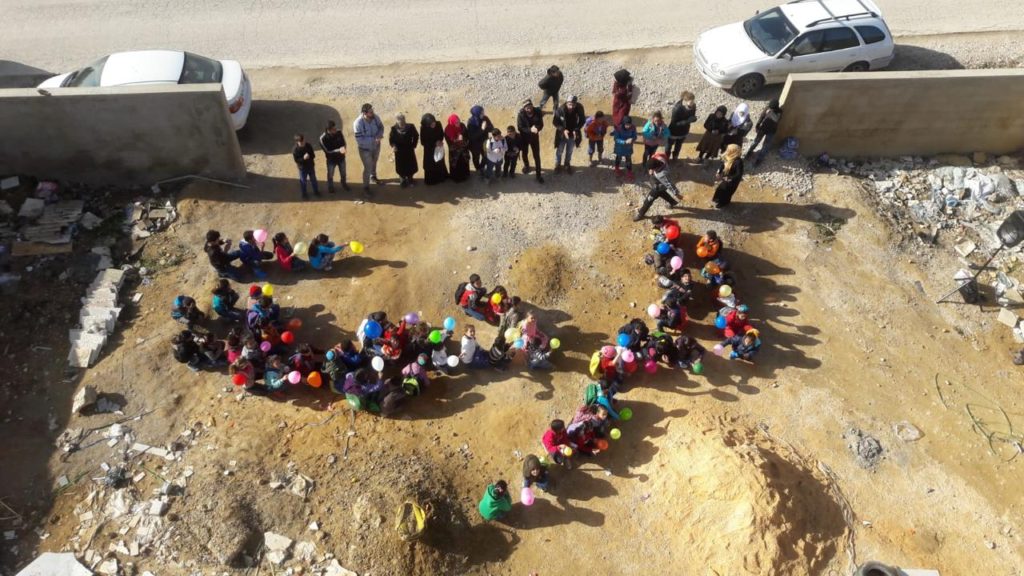
Excited as everyone is the teachers are realizing how much work is still happening around them. They can’t unpack their school supply boxes, the doors to the elevator shaft are not locked yet, it is cold because the heaters are not installed, and the kids are playing around dangerous construction material outside, pretending to sail on the owner’s boat which hasn’t been moved yet. They play games with the children on the break and arrange them to spell out “al rahma” which means “the mercy” and is the first part of the name of our organization in Arabic.
The teachers are excited to have a kitchen and immediately start making hot tea to share on their breaks. I hear children talking to each other about the “beautiful, new school” and who has the more beautiful classrooms. I saw some of the young girls cleaning the stairs after their class and thanked them for taking care of the new building. They responded by saying, “Miss, this building is like our home, we clean our home and we will clean the school too.”
As the week continues we make progress little by little every day. By the end of the week pipes are in place and bathrooms are functioning! All the outlets have covers on them and doors to the elevator shafts are locked! Progress has been made with the heaters—but they aren’t quite ready to use. Drinking water has been delivered and water canisters have been filled! Flooring has been put in the office and we start to unpack boxes a little. The outside area has been smoothed and much of the construction debris burned or cleaned up. There is a small chip stand selling snacks and an older student arranges different races for the students to participate in.
Bit by bit we are getting there and soon we will have a fully function new building!
The sun was shining and it was unusually warm for the January day. In the back of the car, we had the promise of freedom for one teenage boy. We were delivering a cart wheelchair. He had a wheel chair, but with the thin wheels on the large rocks it was useless off the concrete slab that created the floor of their tent house.
We arrived at the home and the men immediately unload the large heavy box and begin to assemble. One of the Triumphant Mercy teachers and the family’s camp leader, puffing on his cigarette the entire time, begin looking at the instruction pictures while Nadine another team member of Triumphant Mercy chatted with the family.
The wheel chair was made for a more “off road” experience and with its wide wheels would do great on the large white rocks that surrounded that their home. Nadine jokes that Farhan, the recipient of the wheel chair, will now be the local “delivery man” as the extra room in the back of the cart would be perfect for this. Farhan, whose name translates to happy in English, sits in the corner not saying a word or engaging in conversation, but anxiously watching the men as they assemble his new “ride.” He sits with one hand over his mouth hiding the small smile that’s been on his face since we arrived.
The men finish their job and we move the chair outside. One of the men helps Farhan into his chair to have him test it out and practice. He holds a serious face while he practices with the hand pedals and the brake. But in an unguarded moment I catch a picture of a smile that’s snuck across his face and a sliver of joy appears. That feeling of knowing that you may have just changed someone’s life comes in my heart and it’s times like this that make all the work worth it.
In my apartment I get up, start making coffee and notice that the snow has turned to rain outside, melting the small piles of snow on cars and in fields. Throughout the morning I see the fickle weather go back and forth from snowing to raining, wind constantly blowing. I cook my eggs and vegetables from my refrigerator and as I eat I think of how small children are sent running errands to buy food for breakfast. Most of the refugees do not a way to store much food and can’t afford to buy food except from day to day. Children as young as 4-5 years old are sent to small shops to buy bread early in the morning for their families.
In the afternoon I get in my car and I drive to visit some camps to see what damage has been done and if I can offer any assistance. I drive past camps and see mattresses and blankets draped on fences to dry, if only the sun would come out from behind the angry looking storm clouds.
Entrance to one of the tent homes.
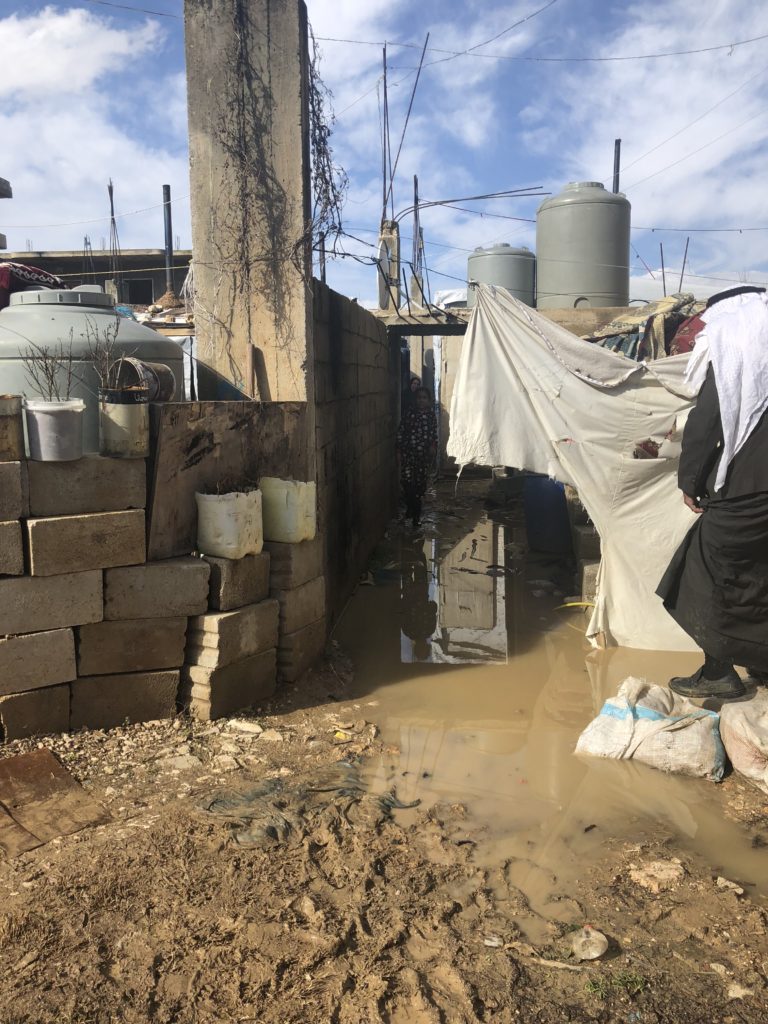
I arrive at one camp and greet a few friends on my way in; their cheeks are bright from sitting in their overly warm tents and coming out into the contrasting cold. As I walk in the camp I speak with some people: tents has been flooded by the storms. In between showers of rain and snow they have started using a pump to get the water out of their homes. One family had a storeroom of food and extra bedding, the bedding can be dried out but the food is destroyed. I see women working quickly, trying to squeegee out their floors. A woman shares with me that they woke up to a drenched mattress and didn’t sleep the rest of the night. The UNHCR reports that 117 informal settlements were affected by this storm and 156 families evacuated and relocated the first day of the storm, 16 families relocated the second day, and 17 more the third day of the storm. These families remained in relative’s or neighbor’s homes, school buildings or community centers until the storm subsided and the water in their tents could be pumped out.
I walk into a second and third camp and speak to people. I watch children running to each other’s tents in sandals despite the wet, muddy freezing temperatures. Sandals are affordable and can be worn year round; boots are expensive and can only be worn a few months. A woman tells me she is so glad that the storm wasn’t all snow because snow is heavy and breaks roofs. She thinks it is easier to deal with the water flooding in and the muddy streets than a broken roof. Nuna comments, “Some of the tents are like shacks, so the winter snow is heavy on the roofs, and some of them had their roofs collapse on them, so they had to find refuge in neighboring tents and they had to rebuild, again.”
Men wander around aimlessly as my friend tells me that it is very hard for them to find work in the winter when the weather is bad. Normally refugee men from camp work manual labor jobs, in the fields or in construction, but when it snows all this work is halted; as is their income.
Winter is a very difficult time in the refugee camps. Families are stuck inside, homes are constantly dirty from the mud tracked in, men cannot find work, they fight a recurring battle against water flooding in, or roofs caving in from heavy snow, it is cold, the small stoves they use can be dangerous for burning children and for catching things on fire.
The brisk winter air flowed in as the door continued to open and close as around 150 children ready for the Christmas camp made their way in. Some showed up at 7:45, even though we didn’t start until 8:30. Their eyes were alight and they were anxious to begin. After check-in they sat waiting, and ready for the story. Hushed and quiet except for the few hellos to teachers that some of our school children hadn’t seen during the Christmas break.
They were ready and waiting. They didn’t know the story. Many of them had never heard it, they had seen the giant Christmas trees go up throughout Beirut, heard the music in every store, glanced at the nativities on every corner and gazed as the lights shimmered in the night for the last month, but they had no idea why. They didn’t know this began with that star long ago sparkling in the night sky telling the wisemen, the king they had been waiting for, was here. So that’s where we started, with the star that told the wisemen that the king that was coming to save the entire world was here.
Rotations of classes with crafts, more story telling, singing and game playing was the plan of the day. The sounds of giggling, singing, and melodies of Christmas music flowed from room to room as the children rotated through each class. In the story room the drama of the story of Mary and Joseph was told and many of the younger children giggled as they thought of Mary traveling all that way on the donkey being that pregnant, many imagining their mom’s belly at the time. The older girls shocked by the scandal of Mary being pregnant without a husband at about their age, likely putting themselves in her place. By the end it was clear why the wisemen were following the star, God was doing a miracle, the king was coming.
At the end of the second day the children were enthusiastically waiting to share what they’d learned. Presentation time commenced. The story was delivered by one of the kids and then the prophesy about the coming child-king was repeated by the older children who had readily memorized it. Last each age group was able to nervously but boldly sing the song about the coming of God to earth that they had worked hard to prepare. Each group watching the others as they showed off their new choreographed song. And at the very end, a dance party teachers and kids rejoiced in the fun that was had over the last couple days.
Then they were off, the crinkling of paper bags filled the entryway as the treats and a gift for each child was taken as they went back to their homes. And now each time they pass the nativity down the road from our center or see the star seated on top of each Christmas tree the story of the coming king that came to save the whole world will cross their minds and God’s demonstration of who He is, Emmanuel becomes more real.
This article was published by Mission Network News. You can read the story on their website by clicking here.
Lebanon (MNN) – The circumstances surrounding refugee camps don’t often breed hope. Yet, hope is exactly what Jo, an English teacher with Triumphant Mercy, brings to her students.
A Place of Waiting
Two years ago, Jo was in a season of waiting. She had come to a place in her life where she didn’t know what to do. She was ready for a big change, to do something for God, but didn’t know what.
She says, “And so I was just laying it all on the table and saying, okay if you want me to go somewhere and if you really lead this way, if you really can, then show me. And I heard Him say, ‘Wait.’”
Jo explains that during that time God taught her about His love and what it looks like to trust Him. To teach her this lesson, she needed a season where only God knew her next steps.
A Time to Go
She became content in her waiting, then without warning, God began to show her what her future held. Jo says, “Suddenly on a random Sunday morning, I walked into Church and Nuna was there. The church there had been praying with her for some of the situations here, in the refugee camp, and she wanted to come and update them about what had been happening. And so, I just happened to hear her update and thought, ‘This has nothing to do with me. This is for sure not where I’m called.’”
Photos Courtesy of Triumphant Mercy
But it was. After praying, talking with people at Triumphant Mercy and visiting the Beqaa Valley, she knew where God was leading her.
“It was very much just a go. Okay then, well then I’ll obey and I’ll go and see where it takes me when I’m there. And now I’ve been here two years and I really feel the Lord’s leading to put things into place to stay for a longer time than I have. So, I’m here for the time being, but I have no idea what that will look like in the long-term.”
Bright Hope for a Dark Place.
The call is clear to stay for now, but that doesn’t mean it is always easy. Triumphant Mercy is running informal schools for Syrian refugees in the Beqaa Valley. Many have seen very difficult things as they escaped with their families into Lebanon.
Yet, Jo senses God’s presence overcoming the dark situations.
“At one point, I felt like I had a picture when I was praying on some time out from being here, of this huge wall of darkness. And I felt like God asked me to come to this place that feels so close to this wall of darkness. But in recognition of who He is, I wouldn’t respond the way you would respond to the darkness. But I would respond the way I would respond to my dad who is God, and who is able, and who gives me joy and freedom and life.
“And so it was this picture of me dancing. And just the blindness when we look into His face to that wall of darkness and it’s not the same as denial, but it’s letting who He is conquer that sense of impossibility. And recognizing that the work is just 100% His.”
Help Bring Hope to the Beqaa
The battle to see God’s hope in dark places is real. Please pray for the teachers in the Beqaa as they seek to shine light into tough situations. Pray that the students learning in Jo’s classroom would see the source of her hope. Jo also asked that while praying for the conflict to end is good, people should pray for the students as individuals who have hopes, dreams and need the love of Christ.
If you want to learn more about Triumphant Mercy’s ministries or help support their continued work in refugee camps in the Beqaa, click here.
This article is published by Missions Network News. You can read the article on their website by clicking here.
Lebanon (MNN) – Winter is expected: colder temperatures, snow, and ice. A winter storm brings that plus a few additional surprises, surprises that aren’t welcome in the Syrian refugee camps in the Bekaa Valley of Lebanon, home to hundreds of thousands.
In the eight years since Syria crumbled into civil war, more than a million Syrians fled to neighboring Lebanon hoping to find safety. They found that, but they also discovered crippling poverty. For a while, the only ones helping were the Christians.
Triumphant Mercy-Lebanon’s (TM-Lebanon) Nuna says the ministry began in 2006 to help Lebanese who were fleeing Hezbollah. From that first step, TM-Lebanon has demonstrated the ability, time and again, to adapt quickly to changing realities on the way to building a stronger community. Yet, this ongoing humanitarian crisis tests their greatest strength. TM-Lebanon started their responseto the refugee wave with emergency food packs, expanding into education centers, warehouses, community centers and into Syria.
Winter Storm Norma
(Image capture of Norma winter storm surge courtesy YtNature)
As recently as last fall, Syrians were being encouraged to go back, and some were considering leaving or making plans to leave Lebanon. Then, winter storm Norma hit, packing heavy rain and snow on Tuesday that turned streets in Lebanon into rivers of water and mud. The UNHCR says the storm seriously damaged 66 refugee camps and destroyed 15.
Nuna tells us, “All the refugees who are living under tents, or who are living in unfinished buildings were really severely hit by this storm, because it was really windy. It’s very cold wind, with no real windows, no real shelter, and also, water coming into the tent because of the heavy water, the mud. Many of the tents have mud inside.” The storm was a setback for many refugee families. “Some of the tents are like shacks, so the winter snow is heavy on the roof, and some of them had their roofs collapse on them, so they had to find refuge in neighboring tents and they had to rebuild, again.”
She says it’s like starting from scratch. Some of the flooded tents saw mud and water destroying what few possessions the refugees had: mattresses, bedding, clothing, food. Some tents were completely submerged. “You feel helpless, in some cases, because how much can you help? How many roofs can you build?” Nuna goes on to say, “All the resources they might have had when they came, maybe they’re completely gone. Kids are growing, they have new babies, families are growing, people are getting married and the resources are so little. What they’re building is really…a shack.”
A Forgotten Crisis
There’s just not enough food, clothing, and shelter. Getting donor support has been challenging because the crisis has fallen off the front page, but Nuna says while the refugee crisis has changed, it hasn’t gone away. “We have to remember that these people are growing in numbers and they’re growing in needs and even though much help has been given, it’s consumed and we have to rebuild again, now.”
Aside from the logistics of meeting emergency needs, there are spiritual needs that weigh heavily, too. Nuna and her staff take the time to listen to the stories of the Syrian refugees, to hear their hopes, of their lost dreams and what’s left of their future. As a result, “They know that we have the compassion of Christ that is compelling us to do something. Jesus says ‘when you see somebody who is hungry, you give him food; somebody who is in prison, you visit him.’ So, when you see somebody who has no shelter, you just do something about it. When you see somebody who has no clothes or shoes, you do something about it.”
Hope For A Future
(Photo courtesy of Triumphant Mercy International)
When the refugees spy a Triumphant Mercy van, they see people coming to them, as Christians, opening their hands, extending a hand of help. It speaks volumes, explains Nuna, adding that she wants other believers to be praying, “That God would just have His way in the midst of misery, that He would be the hope of people and that He would just show them that they are precious in His eyes.”
One last thing: they’re asking for financial help, but the team also needs revitalization. “Also pray that all the people who are working with the refugees, that we would have the human resource, the financial resource and the strength to continue (because it’s draining)….so, a renewed strength, a renewed vision.”
Renewed strength and vision are focal points, especially now that increasing demands face the ministry team. By the way, this weekend’s forecasts calls for more cold temperatures and rain.
Header photo of Syrian Refugee Camp in December, courtesy of Triumphant Mercy Lebanon.
According to the IOM report in 2017, 97 percent of people returned to their own homes that year. According to the recent report by the UNHCR, refugees are mainly traveling to the governorates of Deraa, Damascus, and Homs.
Reuters reports that there are still obstacles in refugees’ way, including documentation, property, and threats against those who deserted the army. There is also a great need to demine certain areas.
The war has generally settled in many parts of Syria, though the battle still rages in the north of the country.
As families feel safer and more confident, they are returning. But not everyone is ready to return.
Reluctance of Children
“We are starting to see them slowly, slowly, they’re feeling more and more safe, but the kids especially are not feeling the safety because they don’t know,” Triumphant Mercy International’sKelsey says.
“You can’t logically explain things to a four-year-old who two years ago remembers waking up in the middle of the night to a huge sound and mom and dad rushing them away.”
Trauma has marred adults and children who have fled the Syrian crises. According to a 2018 report by The Conversation, 45 percent of refugee children suffer from PTSD.
Many have started abusing drugs and alcohol and depression is very high among them. Suicide and self-harm rates have also risen.
Organizations have held trauma counseling in order to help heal adults and children.
“Throughout the whole thing, there has been NGOs who have been inputting into and people that NGOs like Triumphant Mercy can refer kids to, especially kids who have extreme cases,” Kelsey says.
Now, as extreme cases have been addressed, Kelsey says there is evidence of trauma among children, including misbehavior in classes and not being able to control themselves.
Healing before Returning
Right now, Triumphant Mercy’s aim is to help kids heal by the time they return to their home country and learn how they can process through trauma.
“We’re realizing we have to send them back whole and healthy because we can send them back educated, but if they can’t be whole, healthy human beings, they can’t create a good, healthy community,” Kelsey says.
In fact, there are concerns that if children do not heal emotionally, it may lead to a new path of terrorism as they try to fill the void of pain.
In Triumphant Mercy classrooms, teachers are demonstrating to children how they can be open and share about how they feel.
“The first thing we start with is just talking about emotions especially within Middle Eastern, Syrian culture, emotion isn’t really explained by parents. It’s not really emphasized. In fact, it’s actually overlooked and often, parenting is through shame because of the … honor shame culture. Often, we’ll find kids who just don’t know how to express it.”
Kelsey says during a class, she asked a male translator to share about a time he was afraid. Before he could start, a boy kept insisting that men are not afraid.
“There is this expectation on them to put on the front of, ‘we can do it. We’re going to make it happen. We’re not afraid. We’re just going to go.’”
Yet, after fleeing the terror of violence in their home country and finding safety, children are once again faced with the fear of returning.
(Photo courtesy of Triumphant Mercy International)
Kelsey says two kids from a class are preparing to return to Syria, but the children do not want to return.
“They were afraid because when they left, this family specifically, we knew they left because bombs were being dropped on the home next to theirs.”
Healing in Prayer
The process of healing and sharing emotions is important for children so they know how to deal with trauma as they return.
Triumphant Mercy workers have been directing children to prayer to heal.
“Primarily, you let the kids drive the conversation a bit, let them answer the questions, let them ask the questions and then you separate yourself as an individual. ‘When I feel uncomfortable, when I’m afraid, I will pray to God.’”
As families return, pray for safety and complete healing.
This Article originally posted by Missions News Network’s website. If you would like to read the article on the original site please click here.
Syria (MNN) – Syrian refugees are starting to return to their home country, which is changing outreach and ministry programs and the community of different areas.
Returning to Syria
“With international changes, also the [Lebanese] government pressures and even the international pressure for seeing [refugees] to go back home, we can feel it not only in the camps, but everywhere we go,” says Nuna, Triumphant Mercy International’s Director.
Nuna says she’s met young children working at shops in Beirut and asked them why they’re were not in school.
Human Right Watch reports there are 1.5 million school-aged Syrian refugee children in Lebanon, Turkey, and Jordan. Half of them do not have access to formal education.
Many refugee children face barriers to enrolling in schools in their host countries because of child labor, language difficulties, and requirements such as identification registration with the government.
However, Triumphant Mercy is seeing families and children who are not able to attend school in Lebanon returning to their home countries.
Nuna notes Triumphant Mercy’s community center in Beirut has already said goodbye to children who have returned to their homes.
“It’s not a mass-exodus, but it’s more on a personal [scale], just a few at a time. But, it started. The migration back started.”
A Shift of Efforts
With the change of the atmosphere and community, comes the responsibility of adapting ministry efforts.
“We cannot keep ministering the same way,” Nuna says. But, “we can keep testifying the same way. So, we keep [sharing] Christian testimony. Now, we’re trying to think of ways that are accelerating our impact so that when they go back to Syria, that something would be stuck in their minds and in their hearts about Christ.”
Along with ministry efforts, Nuna says the schools will also need to transition. Their goal is to see the number of students decrease in places like Lebanon and increase in Syria.
Triumphant Mercy knows it is important for students, and even for children who haven’t attended school, to have a safe and healing place they can go to on a regular basis as they return to their home country and start resettling.
“So many people have missed years of school in Syria, [and] so many kids are going back. They were not with us. They were not schooled. They will need a transition. They will need to come to a place where they can start to come back on a level where they can actually enter the public school. So, we have lots of work to do there.”
Triumphant Mercy is beginning to tell teachers in Lebanon how they can prepare kids as they return.
For instance, in their schools, they’re holding mid-year and quarterly exams and giving students certificates for each term completed, proving how far they’ve come in their level of education.
Triumphant Mercy is starting a school in Damascus where children can restart and continue their education. Through it, they hope to bring educational, spiritual, and emotional healing.
Challenges in Returning
Nuna says one of the challenges is knowing how to help refugees return.
She also says there is need for mental preparation due to “psychological trauma that was there because of what they experience in Syria needs to be worked on so they will not have fear anymore to go back. That’s now the challenge for us. It’s not anymore how to accommodate them to come. It’s more like to prepare them psychologically to go back,” Nuna says.
“This is now our role, I think, in the next season – prepare them psychologically and emotionally to go back home and at the same time, having them know that we are already there. So, that helps them know that at least [they] have somebody there who can help [in Syria].”
Another challenge Triumphant Mercy has been faced with both in Lebanon and will continue facing is working with a generation that has ultimately been forced to raise themselves –in all respects, a fatherless generation.
Nuna says parents have been focused on finding resources, finances, and security, so they haven’t been able to raise their children.
Though the war in certain areas of Syria has died down, the scars of it have been left on this generation, and they haven’t had strong parental figures to guide them, showing them right from wrong.
Drug abuse, smoking, and alcohol use are all growing among kids, especially in refugee camps.
“This is not usual in Islamic regions. Alcohol is prohibited, but yet, now, you can just see alcohol everywhere, even inside Syria in the Islamic areas,” Nuna says.
Get Involved
(Photo courtesy of Triumphant Mercy International)
As refugees continue returning to Syria, pray they will remember who Christ is, pray they will choose to follow Him and share His Word with the neighbors back home. Pray for the fatherless generation to see that God is the ultimate Father who will always be there for them.
Pray also for the rebuilding of Syria and that organizations will help financially and with building resources.
Finally, pray for Triumphant Mercy’s school and for civilians’ safety. Nuna says the war is slowing down, but a battle is coming to the north of Syria.
“They’re getting ready. They’re moving all the troops there and we can see that the battle is going to start. Whether they would come into Lebanon or not, I don’t know.”